2026 Hybrid Work-Life Balance: 5 Strategies That Work
Anúncios
Hybrid Work-Life Balance in 2026 depends less on simply working from home and more on clear boundaries, coordinated schedules, realistic workloads, communication norms and deliberate recovery time.
Hybrid work remains the dominant arrangement among remote-capable U.S. employees, but flexibility does not automatically eliminate stress or burnout.
Hybrid Work-Life Balance has become a central workplace issue for professionals navigating schedules that combine remote and on-site work across the United States.
In 2026, hybrid work remains the most common arrangement among employees in remote-capable roles, while organizations continue refining policies around office attendance, collaboration and employee autonomy.
The challenge is no longer simply whether hybrid work exists, but how employees and managers can structure it so flexibility supports performance without allowing work to expand continuously into personal time.
Anúncios
Understanding the Hybrid Work Landscape in 2026

Hybrid work remains a durable part of the U.S. workplace rather than a temporary arrangement left over from earlier remote-work experiments.
Gallup’s 2026 data show that 52% of employees in remote-capable U.S. jobs work hybrid, while 26% work exclusively remotely and 22% work fully on-site.
These figures suggest that hybrid work-life balance is now a long-term management and personal planning issue rather than a short-term adaptation.
Hybrid Work Is the Dominant Model for Remote-Capable Roles
Gallup reports that roughly half of full-time U.S. employees hold jobs that can be performed remotely at least part of the time.
Among those workers, hybrid arrangements remain more common than either fully remote or fully on-site schedules, with overall patterns staying relatively stable since 2022.
This stability means employers increasingly need to focus on how hybrid teams coordinate rather than repeatedly treating flexible work as an experiment.

Flexibility Can Help Without Solving Every Workplace Problem
Gallup research shows that many hybrid workers report improved work-life balance, greater autonomy and better ability to structure focused work around personal responsibilities.
Anúncios
However, hybrid and remote arrangements do not automatically improve overall well-being, especially when workloads, expectations or communication practices remain poorly managed.
In the United States and Canada, half of employees reported significant daily stress in the latest 2026 workplace data, showing that flexibility alone is not a complete solution.
Strategy 1: Establish Clear Work and Personal Boundaries
Clear boundaries are one of the most practical foundations of a sustainable hybrid work-life balance, especially when work and home occupy the same physical environment.
Without defined stopping points, email, messaging and unfinished tasks can extend the workday even when an employee technically has flexible hours.
The objective is not to create rigid separation in every situation, but to establish predictable signals that distinguish working time from personal time.
Create a Defined Start and End to the Workday
A consistent starting routine can help employees shift attention toward work, while an equally deliberate shutdown routine can create a clearer transition out of professional responsibilities.
That transition might include reviewing unfinished tasks, planning the next day and closing work applications instead of leaving them continuously visible.
The routine does not need to be elaborate; consistency matters more than the specific activity used to separate the two parts of the day.
Use Physical Separation When Possible
A dedicated room is not required, but assigning a particular desk, table or area to professional tasks can make work feel more contained.
When the workday ends, leaving that area or storing equipment can provide a visible signal that professional responsibilities have paused.
For smaller homes, even modest changes such as closing a laptop and removing work materials can help reduce the sense that work is always present.
Set Digital Boundaries as Well
Work notifications can undermine personal time when messages arrive continuously through phones, watches and other devices after normal working hours.
Where job responsibilities allow, employees can use notification schedules, status settings and separate work profiles to reduce unnecessary interruptions.
These tools should reflect organizational expectations, because employees in genuinely on-call roles may need different boundaries from workers with fixed availability.
Strategy 2: Improve Time Management Without Over-Scheduling
Effective time management can help hybrid employees organize tasks across home and office days without turning every hour into a rigid productivity target.
Calendars and task systems are most useful when they create realistic priorities, protect concentration and reserve space for breaks and unexpected work.
The goal is to manage limited attention more deliberately rather than simply increasing the number of activities packed into each day.
Match Tasks to the Best Work Environment
Different tasks may benefit from different environments, depending on noise, equipment, collaboration needs and the employee’s individual ability to concentrate.
Team discussions, onboarding or complex collaboration may be useful on shared office days, while concentrated individual work may sometimes be easier remotely.
There is no universal formula, so employees and teams should evaluate which activities genuinely benefit from being performed together in person.
Protect Time for Focused Work
Back-to-back meetings can fragment attention and make it difficult to complete tasks that require uninterrupted concentration during the workday.
Employees can use calendar blocks or agreed team practices to protect periods for focused work when their role and workplace culture allow it.
This strategy can also reduce the temptation to finish substantial unfinished work during evenings that would otherwise remain personal time.
Use Productivity Techniques as Tools, Not Rules
Methods such as the Pomodoro Technique or task-prioritization frameworks can help some people structure concentration and breaks.
They are not universally superior, and the best method depends on job demands, attention patterns and how frequently collaboration interrupts individual work.
Employees should evaluate whether a technique actually improves output and reduces stress instead of continuing it only because it is widely recommended.
Strategy 3: Prioritize Recovery and Well-Being
A sustainable hybrid work-life balance requires enough recovery time for employees to maintain attention, energy and personal responsibilities outside work.
Hybrid schedules can create additional flexibility, but that flexibility can disappear if saved commuting time is simply converted into a longer workday.
Well-being strategies work best when they focus on realistic routines rather than treating every employee as if the same habits will produce identical results.
Take Real Breaks During the Workday
Brief pauses can help interrupt long periods of sitting, screen exposure and sustained concentration, particularly during remote days with fewer natural transitions.
A break does not need to involve formal mindfulness practice; walking, eating away from the desk or completing a simple non-work activity can provide separation.
The most useful approach is one that actually interrupts work rather than replacing one screen-based activity with another while remaining mentally engaged with the job.
Protect Sleep and Non-Work Time
Late-night email and irregular schedules can make it difficult to create a consistent period in which work no longer competes for attention.
Employees can reduce this spillover by identifying an approximate end point and resisting unnecessary work after that time when responsibilities allow.
Sleep needs differ among individuals, but chronic reductions in rest should not be treated as a reasonable cost of maintaining flexibility or professional visibility.
Use Self-Care Without Treating It as a Cure for Workload Problems
Activities such as exercise, hobbies and self-care can support well-being, but they cannot compensate indefinitely for excessive workloads or unclear expectations.
If work continually exceeds realistic capacity, the solution may involve prioritization, workload discussion or management intervention rather than simply adding another wellness routine.
This distinction matters because hybrid work-life balance depends on both individual habits and organizational conditions.
Strategy 4: Build Clear Communication Norms in Hybrid Teams
Communication can become more complicated in hybrid teams because some employees share a physical workspace while others receive information through digital channels.
Without clear norms, employees may feel pressure to monitor several platforms continuously or attend unnecessary meetings simply to remain informed.
Teams can reduce that pressure by agreeing on which channels are used for urgent requests, updates, documentation and decisions.
Use Synchronous and Asynchronous Communication Deliberately
Not every update requires a meeting, and not every complex issue can be resolved efficiently through a long chain of text messages.
Routine status information can often be shared asynchronously, while discussions that require rapid interaction may benefit from live conversation.
A clear distinction between these modes can reduce meeting volume and make employees less dependent on constant real-time availability.
Shared Team Norms Can Improve Perceptions of Fairness
Gallup reports that hybrid schedules designed collaboratively by teams are perceived as fair more often than schedules determined exclusively by senior leadership.
This does not mean every employee can choose any schedule they prefer, because business requirements and customer needs may still impose constraints.
It does suggest that teams can benefit from discussing why particular in-office days or collaboration expectations exist instead of relying only on top-down mandates.
Managers Should Focus on Outcomes and Clarity
Trust can become a problem when managers equate physical visibility with productivity and employees feel pressure to demonstrate that they are constantly online.
Clear objectives, deadlines and ownership allow performance to be evaluated through outcomes instead of activity signals such as status lights or message frequency.
This approach can support autonomy while still preserving accountability, which is important for both team performance and hybrid work-life balance.
Strategy 5: Create a Formal Hybrid Collaboration Plan
Hybrid teams function more effectively when schedules, communication norms and collaboration expectations are documented rather than assumed.
Gallup reports that teams with formal hybrid collaboration plans show higher engagement and lower burnout than comparable teams without structured coordination.
The plan does not need to be complicated, but it should answer basic questions about where people work, how decisions are shared and when synchronous collaboration is expected.
Define What Office Time Is Actually For
Office attendance creates more value when teams know which activities are intentionally being performed together instead of simply reproducing remote work from separate desks.
Planning, mentoring, problem solving and relationship-building may benefit from shared presence, depending on the role and nature of the team’s work.
If employees commute only to spend the entire day in virtual meetings, they may reasonably question the purpose of the office requirement.
Document Decisions for People Who Are Not Present
Informal conversations can create information gaps when important decisions are made by employees who happen to share the same physical location.
Recording key decisions, responsibilities and deadlines in a shared workspace helps prevent remote colleagues from becoming dependent on secondhand information.
This practice supports a more consistent employee experience and reduces the risk that proximity becomes an unintended advantage within hybrid teams.
Review the Plan Instead of Treating It as Permanent
Project demands, team membership and business priorities can change, making an initially effective hybrid schedule less useful over time.
Periodic reviews give teams an opportunity to identify unnecessary meetings, coordination gaps or office days that no longer serve their original purpose.
Adjustments based on actual experience can make the system more practical than applying the same hybrid structure indefinitely.
Technology Can Support or Undermine Hybrid Work-Life Balance
Digital tools make hybrid work possible by connecting employees across locations, but they can also create expectations of permanent availability.
Messaging, video conferencing and collaborative documents are useful when they reduce friction, while excessive tools can increase notifications and information overload.
The goal should be to use technology intentionally so that it supports the work rather than expanding the amount of attention required to manage the technology itself.
Reduce Notification Overload
Multiple platforms can create repeated alerts for the same project, making every incoming message appear equally urgent regardless of its actual importance.
Employees can adjust notification settings and teams can establish response-time expectations so routine messages do not require immediate interruption.
These practices can improve focus during the workday and make it easier to disconnect when professional responsibilities end.
Use Shared Documentation to Reduce Repetitive Meetings
Project documentation, meeting notes and clear decision records can answer common questions without requiring additional calls or repeated status discussions.
This approach is particularly useful when hybrid employees work slightly different schedules or are distributed across locations and time zones.
Better documentation does require effort, but it can reduce the amount of coordination that depends on everyone being available at the same time.
Digital Detoxes Are Optional, Not a Universal Requirement
Some professionals find scheduled periods away from work technology useful, while others prefer less formal boundaries around their personal device use.
A digital detox can be helpful if constant checking creates stress, but it is not necessary for everyone to disconnect in exactly the same way.
The more important principle is that employees should have predictable periods when routine work communication does not demand their attention.
AI Is Becoming Part of the Hybrid Work Environment
Artificial intelligence is increasingly integrated into workplace tools, creating another layer of change for employees managing hybrid schedules in 2026.
Gallup reported that half of employed U.S. adults used AI in their role at least occasionally by early 2026, while frequent usage was also increasing.
AI may reduce time spent on selected tasks, but its effect on hybrid work-life balance depends on how organizations integrate the technology into actual workflows.
AI Access Alone Does Not Improve the Employee Experience
Gallup’s 2026 workplace findings indicate that simply giving employees access to AI does not automatically improve engagement or overall work experience.
Employees report better outcomes when leadership provides clear expectations, practical implementation plans and active support from managers.
This suggests that technology creates value when work processes change thoughtfully instead of when organizations simply add another tool to an already complex environment.
Efficiency Gains Should Not Automatically Become More Work
If AI helps an employee complete certain tasks faster, organizations must decide whether that saved time reduces workload or simply increases expectations for additional output.
Without deliberate workload management, productivity technology can contribute to work intensification rather than creating additional flexibility or recovery time.
Managers should therefore evaluate both output and workload when introducing new automation into hybrid teams.
Hybrid Work Can Improve Engagement Without Guaranteeing Well-Being
Gallup data show that hybrid and remote-capable employees often report stronger engagement than remote-capable employees who work entirely on-site.
However, engagement and overall life well-being are different measures, and a highly engaged worker can still experience stress, fatigue or personal pressure.
This distinction is important because hybrid work-life balance should not be evaluated through productivity or engagement alone.
Recent U.S. Data Still Show High Workplace Stress
Gallup’s 2026 regional data show that 50% of employees in the United States and Canada reported significant daily stress.
Employee engagement in the region stood at 31%, while loneliness and other negative daily emotions remained meaningful workplace concerns.
These results show why hybrid policies should be evaluated alongside workload, management quality and employee experience rather than flexibility alone.
Employee Preferences Also Matter
Gallup reports that a majority of remote-capable workers prefer hybrid arrangements, while fewer employees prefer being fully on-site.
When actual work arrangements align more closely with employee preferences, engagement and retention outcomes may improve compared with arrangements employees strongly dislike.
Business requirements still matter, but organizations can benefit from understanding preference rather than assuming one location policy will suit every remote-capable role.
Burnout Prevention Requires Organizational Action
Burnout is often discussed as an individual problem, but workload, management practices and unclear priorities can contribute significantly to persistent exhaustion.
Hybrid workers may gain commuting flexibility while simultaneously facing meeting overload, digital availability expectations and fragmented collaboration across different locations.
A strong hybrid work-life balance therefore requires organizations to examine how work is designed rather than relying entirely on employees to manage the consequences.
Formal Coordination Can Reduce Burnout Risk
Gallup reports that hybrid employees working within teams that have formal collaboration plans are less likely to report burnout than those without structured coordination.
Clear schedules and communication norms can reduce uncertainty about when employees need to be available and which interactions require real-time participation.
This type of coordination can remove unnecessary friction without reducing accountability or preventing teams from adapting when business needs change.
Managers Need Realistic Workload Visibility
Remote and hybrid work can make workload problems less visible because managers do not always observe when employees routinely work beyond expected hours.
Regular discussions about priorities, capacity and deadlines can help identify overload before it becomes a persistent pattern.
This is different from monitoring employees continuously, because the objective is understanding workload rather than measuring presence or screen activity.
Continuous Learning Helps Hybrid Workers Adapt
Hybrid work continues to evolve alongside communication tools, AI adoption and changing organizational policies, making adaptability an important professional skill.
Employees may need to learn new collaboration systems, adjust meeting habits or reconsider how they structure home and office days as their roles change.
Continuous learning should support better work rather than creating another expectation that employees spend all personal time developing professional skills.
Seek Feedback on How Your Hybrid Routine Works
Feedback from colleagues and managers can reveal coordination problems that are difficult to identify from an individual perspective.
An employee may believe a particular schedule is efficient while teammates experience delays because collaborative work repeatedly occurs on different days.
Constructive feedback can help refine routines without requiring the employee to abandon the flexibility that makes the hybrid arrangement valuable.
Review Personal Routines Periodically
A schedule that works during one project or stage of life may become less effective when responsibilities, commute patterns or household needs change.
Periodic review gives employees an opportunity to identify where work is expanding unnecessarily into personal time or where routines have become inefficient.
The objective is continuous adjustment rather than pursuing a permanent ideal version of hybrid work-life balance.
What Employees Can Control and What They Cannot
Employees can influence boundaries, scheduling, communication habits and how they organize their own work, but they do not control every condition affecting work-life balance.
Company workload, staffing, manager expectations, compensation and mandatory office policies can significantly influence whether individual strategies succeed.
A useful guide should therefore separate personal practices from structural workplace factors instead of suggesting that every problem can be solved through better self-discipline.
Individual Strategies Work Best With Organizational Support
Boundary-setting becomes difficult when managers routinely send urgent requests late at night or reward employees who remain continuously available.
Likewise, calendar management cannot solve workload problems when employees receive more assignments than can realistically be completed during normal working hours.
Organizations that want sustainable hybrid work need policies and management behaviors that support the practices employees are encouraged to adopt.
Discuss Persistent Problems Instead of Normalizing Them
If excessive hours, meeting overload or conflicting expectations continue despite individual adjustments, employees may need to raise the issue with a manager or relevant workplace resource.
Not every problem will have an immediate solution, but documenting patterns can make discussions more specific than simply saying work feels overwhelming.
This approach recognizes that hybrid work-life balance is a shared management challenge rather than solely an individual responsibility.
A Practical Hybrid Work-Life Balance Checklist
A short checklist can help employees evaluate whether flexibility is genuinely improving their working life or simply changing where the same pressures occur.
The most useful questions focus on boundaries, workload, communication and recovery rather than counting the number of days spent at home or in the office.
Reviewing these areas periodically can reveal whether a hybrid arrangement needs adjustment before small inefficiencies become persistent sources of stress.
Questions to Review Each Month
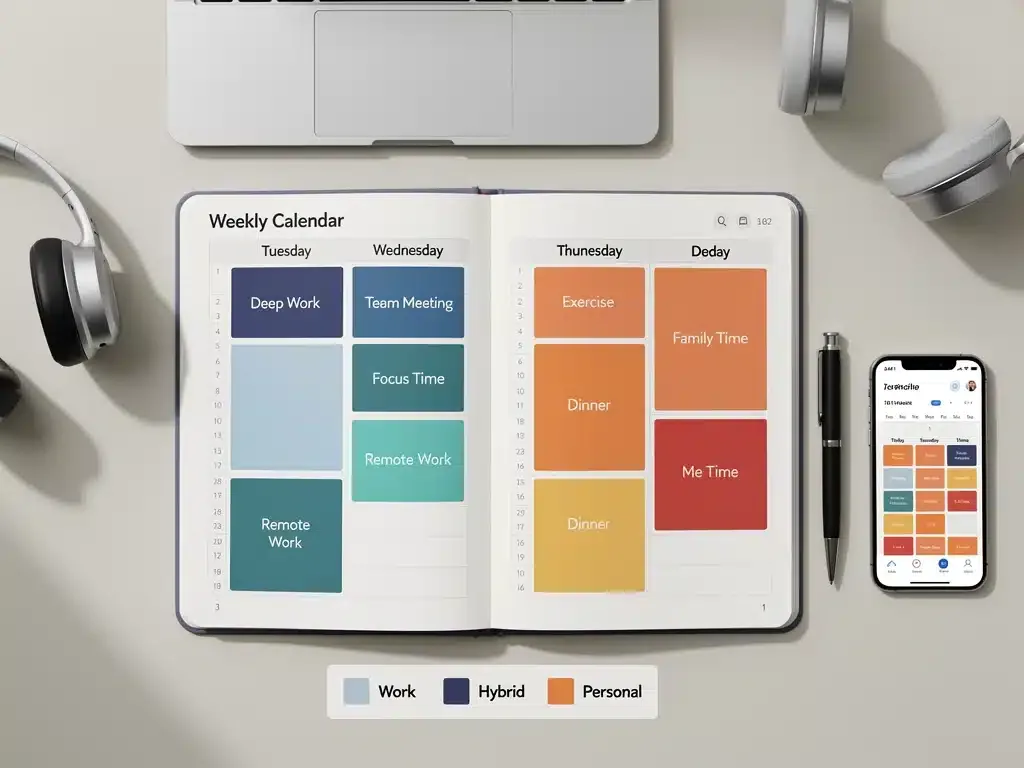
Ask whether work regularly extends beyond intended hours, whether meetings prevent focused work and whether office days have a clear purpose.
Also consider whether notifications interrupt personal time and whether teammates understand expectations around response times and availability.
If several answers consistently indicate problems, the next step may involve changing routines or discussing team-level improvements rather than simply working harder.
- Do I have a predictable start and end to most workdays?
- Are work notifications interrupting personal time unnecessarily?
- Do office days have a clear collaborative purpose?
- Do I have enough uninterrupted time for focused work?
- Are meeting expectations realistic?
- Does my manager understand my workload?
- Can teammates find important information without scheduling another meeting?
- Am I regularly recovering outside work hours?
Use the Checklist as a Diagnostic Tool
The checklist is not a scorecard that defines whether someone has succeeded or failed at balancing work and personal responsibilities.
Instead, it helps identify patterns that may deserve attention, especially when the same problem appears repeatedly across several weeks.
This approach keeps hybrid work-life balance practical and adaptable rather than turning it into another standard employees feel pressured to perfect.
| Key Strategy | How It Supports Hybrid Work-Life Balance |
|---|---|
| Clear Boundaries | Creates more predictable separation between working time and personal time. |
| Time Management | Protects focused work and reduces unnecessary spillover into evenings. |
| Recovery | Preserves breaks and non-work time instead of turning all flexibility into additional work. |
| Team Norms | Clarifies when meetings, office attendance and rapid responses are actually necessary. |
| Regular Review | Allows schedules and routines to adapt as work and personal circumstances change. |
Frequently Asked Questions About Hybrid Work-Life Balance
Is hybrid work the most common arrangement for remote-capable U.S. employees in 2026?▼Yes. Gallup’s 2026 data show that 52% of employees in remote-capable U.S. jobs work hybrid, compared with 26% fully remote and 22% fully on-site.
Does hybrid work automatically improve work-life balance?▼No. Many hybrid employees value flexibility, but outcomes depend on workload, boundaries, management practices, trust and team coordination. Flexibility alone does not eliminate workplace stress.
How can I set better boundaries while working from home?▼Use a consistent start and end routine, create a defined workspace when possible, manage work notifications and communicate realistic availability expectations with colleagues.
Are digital detoxes necessary for every hybrid worker?▼No. Some people find scheduled digital breaks helpful, but the more important goal is having predictable periods when routine work communication does not demand attention.
Can hybrid workers still experience burnout?▼Yes. Hybrid work can improve flexibility while still involving high workloads, meeting overload, unclear expectations or constant digital availability. Structured team coordination can help reduce these risks.
Should all collaborative work happen in the office?▼No. Some activities benefit from in-person interaction, while others can be handled effectively through asynchronous or virtual collaboration. Teams should decide based on the purpose of the work.
What This Means for Hybrid Professionals in 2026
Hybrid Work-Life Balance in 2026 is less about finding a perfect schedule and more about creating clear, sustainable ways to manage attention, workload and personal time.
Current U.S. workplace data show that hybrid work remains durable, but employee stress and engagement challenges demonstrate that flexibility needs strong management and coordination to work well.
The most effective approach combines individual boundaries with realistic workloads, team norms and regular adjustment instead of assuming remote flexibility alone will produce better well-being.